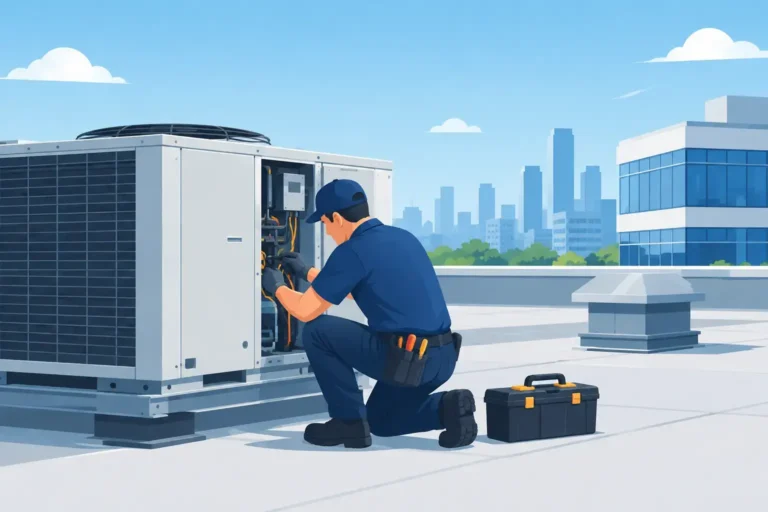

A rooftop HVAC unit can be easy to overlook until it stops cooling a dining room on a hot July afternoon or leaves an office cold during a South Dakota winter morning. Then the problem becomes much bigger than equipment on the roof. It affects employees, customers, inventory, tenants, and the normal pace of your business. Prompt rooftop unit repair helps contain that disruption before a minor mechanical issue turns into a shutdown.
For business owners and property managers in Yankton, Vermillion, and surrounding communities, the right response is not guessing at the cause or repeatedly resetting the thermostat. A commercial rooftop unit is a complex system that combines heating, cooling, ventilation, electrical controls, and safety components in one cabinet. It needs a trained technician who can diagnose the full system, explain the findings clearly, and make a repair that holds up.
When Rooftop Unit Repair Should Not Wait
Some rooftop unit problems are obvious. The space will not cool, the heat will not start, or the system will not run at all. Others show up gradually and are easy to put off during a busy week. A manager may notice that one area is warmer than the rest of the building, that the unit cycles on and off more often, or that utility bills have climbed without a clear reason.
Those changes are worth acting on early. A unit that runs constantly may be dealing with restricted airflow, a refrigerant issue, dirty coils, failing controls, or an oversized demand caused by building conditions. Continuing to operate it can add wear to compressors, blower motors, and electrical components while delivering less comfort.
Call for service promptly if you notice unusual banging, rattling, squealing, burning odors, water stains near ceilings, ice on refrigerant lines, tripped breakers, or a gas smell. Gas odors, sparking, smoke, and carbon monoxide concerns require immediate attention. Keep people away from the affected area when needed and contact a qualified commercial HVAC professional.
A leak around a rooftop unit also deserves a fast response. Condensate backups, damaged drain lines, failed roof curbs, and deteriorated flashing can allow water into the building. What starts as an HVAC repair can quickly become a ceiling, insulation, flooring, or mold problem if it is ignored.
What a Professional Rooftop Unit Repair Visit Includes
A dependable repair begins with diagnosis, not a quick part swap. Rooftop units may have similar symptoms for very different reasons. For example, insufficient cooling could be caused by a failed capacitor, a dirty condenser coil, a blower problem, low refrigerant charge, a control-board fault, or a thermostat communication issue. Replacing one part without testing the system can leave the real problem behind.
A technician will start by reviewing the complaint and inspecting the unit’s overall condition. That includes checking filters, blower operation, belts where applicable, electrical connections, contactors, capacitors, motors, coils, drains, refrigerant pressures, and safety controls. On gas heat sections, the work may also include examining ignition components, burners, gas pressure, venting, heat exchangers, and combustion performance.
Airflow is a major part of the diagnosis. A unit may produce heated or cooled air but still fail to keep the building comfortable because the blower is underperforming, filters are plugged, dampers are mispositioned, or ducts are leaking. Commercial comfort depends on how the entire system works together, not simply whether the unit turns on.
Before repairs are made, the technician should explain what failed, why it matters, and what options are available. In some cases, a straightforward repair is the clear answer. In others, such as an older unit with a major compressor failure or a compromised heat exchanger, it makes sense to compare the repair cost, expected remaining service life, efficiency, and replacement options.
Repairs That Commonly Affect Commercial Rooftop Units
Wear and weather take a toll on rooftop equipment. South Dakota units handle summer heat, winter cold, wind, snow, and long operating hours. Common repair needs include replacing worn belts, failed blower motors, capacitors, contactors, relays, sensors, economizer components, thermostats, and control boards.
Cooling repairs can involve cleaning coils, correcting airflow restrictions, repairing refrigerant leaks, replacing damaged fan motors, or addressing compressor-related issues. Heating repairs often involve ignition systems, flame sensors, inducer motors, gas valves, limit switches, or burner adjustments. Each repair should be followed by operational testing so the system is not only running, but operating safely and as intended.
The Cost of Waiting Can Be Higher Than the Repair
It is understandable to want to delay a repair when a unit is still operating part of the time. But a struggling rooftop unit generally does not fix itself. A weak capacitor can strain a motor. A dirty coil can force the compressor to work harder. A blocked condensate drain can cause water damage. A small electrical issue can grow into a damaged control system.
Waiting also creates operational costs. Uneven temperatures can make a retail store less inviting, disrupt office productivity, frustrate tenants, or affect customers in a restaurant, clinic, or other public-facing space. For facilities with sensitive equipment or inventory, temperature and humidity swings may create additional risks.
Emergency repairs sometimes cannot be avoided, especially after severe weather or an unexpected component failure. Still, planned service gives you more control over scheduling, budget, and downtime. It also gives a technician the chance to find small issues while parts and repair decisions are less urgent.
Preventing Repeat Rooftop Unit Problems
Preventive maintenance is one of the most practical ways to protect commercial HVAC equipment. It does not eliminate every breakdown, but it can reduce avoidable failures and help a system run more efficiently through demanding weather.
A well-maintained unit receives regular filter changes, coil cleaning as needed, electrical inspections, lubrication where required, belt checks, drain cleaning, airflow testing, and verification of heating and cooling operation. Technicians can also identify loose connections, aging components, damaged insulation, and signs of refrigerant or water leaks before they become urgent.
Maintenance schedules depend on the equipment, the building’s use, operating hours, and the environment around the unit. A restaurant, gym, workshop, or busy retail location may need more attention than a lightly used office. Units near cottonwood trees, construction dust, kitchen exhaust, or heavy traffic may also need more frequent coil and filter service.
Protect the Unit and the Building Around It
The roof area matters, too. Keep access paths clear and make sure service technicians can safely reach the equipment. Avoid placing materials around the unit that block airflow or interfere with panels. After storms, check for visible debris, damaged panels, or standing water near the equipment without climbing onto the roof or opening the cabinet yourself.
It is also wise to track recurring comfort complaints by location and time of day. If the same room is hot every afternoon, that detail can help identify whether the issue is equipment capacity, airflow, controls, solar load, or a zoning problem. Clear information helps speed up diagnosis and supports better long-term decisions.
Repair or Replace? Make the Decision With Real Information
There is no single age at which every rooftop unit should be replaced. Some systems are good candidates for repair well into their later years when they have been maintained and the needed work is reasonable. Others become costly to operate or repair because of repeated failures, obsolete components, poor efficiency, corrosion, or a major failure in a system near the end of its useful life.
A repair-versus-replacement decision should account for the immediate repair, the unit’s condition, recent repair history, energy use, building comfort, and the cost of disruption if it fails again. A newer unit with a failed electrical component usually calls for repair. An older unit with major refrigerant circuit problems and a history of breakdowns may justify a replacement discussion.
Larry’s Plumbing, Heating and Cooling provides commercial HVAC support with the goal of giving local businesses a clear path forward, not pressure. Whether the answer is a targeted repair, scheduled maintenance, or planning for a new rooftop unit, you deserve a recommendation based on the condition of your equipment and the needs of your facility.
If your rooftop unit is making noise, losing capacity, leaking, cycling unexpectedly, or failing to maintain a comfortable space, schedule service before the next weather swing turns a manageable problem into an emergency. A properly diagnosed repair can help keep your building comfortable and your business focused on the work in front of it.